Real-Time Soil Monitoring
IoT sensors can monitor soil moisture, temperature, humidity, pH, and other environmental parameters so farmers can make informed decisions about irrigation and crop management.

Smart Agriculture System Using IoT
Agriculture is evolving from traditional farming practices to data-driven, connected, and intelligent operations. A smart agriculture system using IoT enables farmers and agricultural businesses to monitor crops, soil, weather, irrigation, livestock, and equipment in real time.
What Is Smart Agriculture Using IoT?
A smart agriculture system uses connected sensors and IoT devices to continuously collect information from agricultural environments. Soil moisture, temperature, humidity, rainfall, water levels, crop conditions, equipment status, and other parameters can be monitored through a centralized platform.
This approach brings together IoT and agriculture to create a connected farming environment where farmers can monitor operations remotely and take timely actions based on real-time information.
Instead of relying only on manual observation or historical assumptions, farmers can use data to determine when to irrigate, identify environmental changes, monitor crop health, and optimize the use of water, fertilizers, energy, and other resources.
How IoT Is Transforming Agriculture
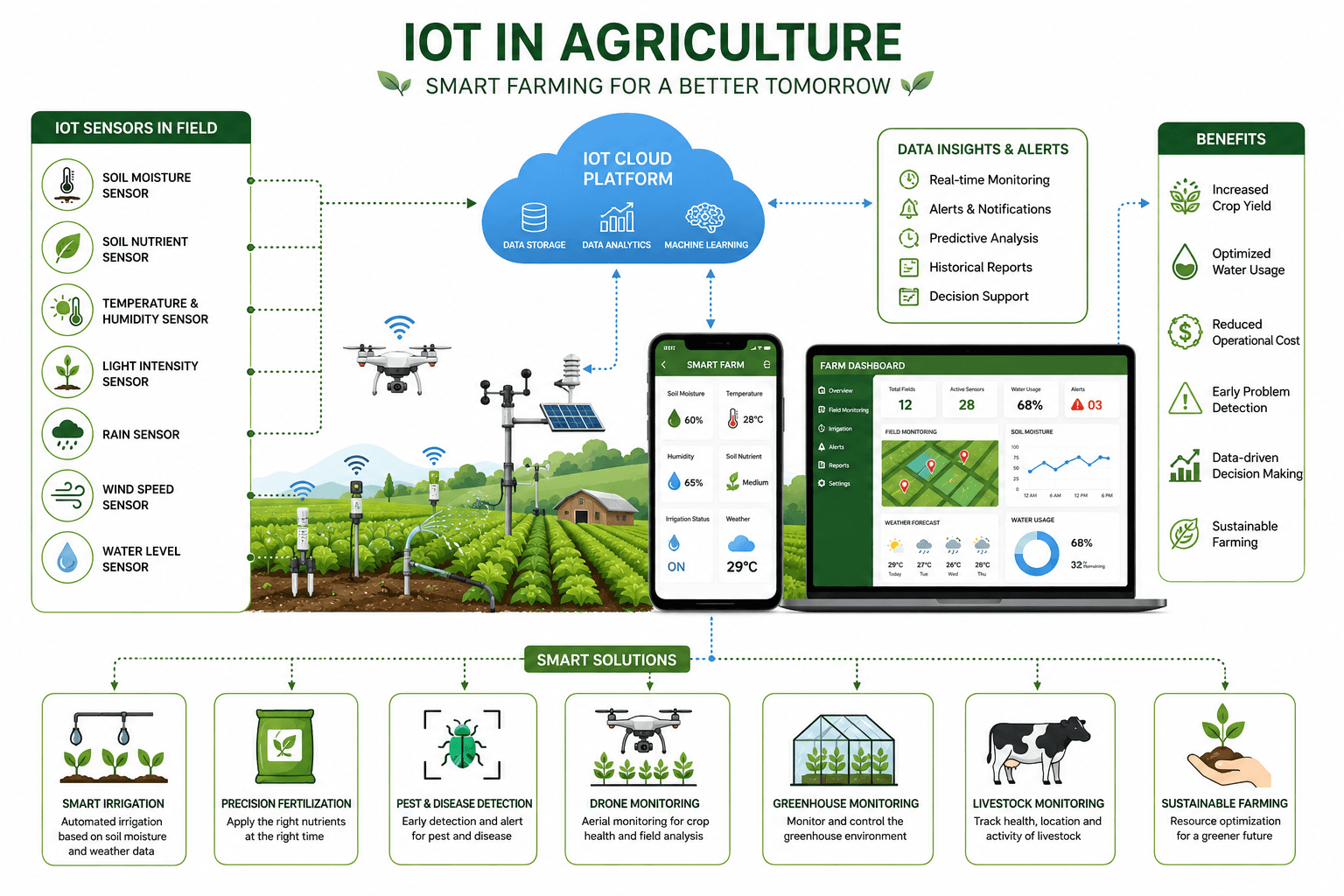
The integration of the Internet of Things in agriculture is changing how farms are monitored and managed. Connected technologies provide continuous visibility into farming conditions while automation reduces repetitive manual tasks.
IoT sensors can monitor soil moisture, temperature, humidity, pH, and other environmental parameters so farmers can make informed decisions about irrigation and crop management.
A smart irrigation system can use real-time soil and environmental data to determine irrigation requirements and help deliver water when it is needed.
Connected weather stations can monitor temperature, humidity, rainfall, wind, and other environmental conditions to help farmers plan agricultural activities.
IoT devices and connected systems can provide continuous information about crop-growing conditions. Combined with analytics and AI, this data can support early identification of potential crop-related issues.
Connected agricultural machinery can be monitored for location, utilization, operating conditions, fuel consumption, and maintenance requirements.
A centralized smart farming system allows farmers, managers, and agricultural teams to access important farm information remotely through web and mobile applications.
Smart Agriculture System Using IoT – Key Features
Our smart agriculture using IoT solutions can combine sensors, gateways, applications, cloud infrastructure, analytics, and automation into a unified platform.
Connect soil sensors, weather sensors, water-level sensors, temperature sensors, humidity sensors, GPS devices, cameras, and other agricultural IoT devices.
Create automated irrigation workflows based on soil moisture, weather conditions, predefined thresholds, schedules, and crop requirements.
Track important soil parameters and visualize historical and real-time data to support more informed crop management.
Collect and analyze environmental data from connected weather stations and sensors deployed across agricultural locations.
Monitor individual fields, zones, and agricultural plots through centralized dashboards and connected devices.
Receive notifications when sensor readings cross predefined thresholds or when specific environmental or equipment conditions require attention.
Monitor connected tractors, pumps, irrigation equipment, and other agricultural assets.
Convert agricultural IoT data into dashboards, reports, trends, KPIs, and actionable insights.
Give farmers and field teams access to real-time farm information through mobile applications.
Use AI for agriculture to identify patterns, detect anomalies, support crop monitoring, forecast conditions, and provide intelligent recommendations.
Technologies Used in Smart Agriculture
Modern technologies in agriculture are bringing together IoT, AI, cloud computing, automation, computer vision, GPS, and data analytics to create more intelligent farming systems.
Sensors continuously collect information from soil, crops, equipment, irrigation systems, and the surrounding environment.
Cloud platforms provide centralized storage, processing, visualization, and management of large volumes of agricultural data.
AI for agriculture can analyze large datasets to identify patterns, generate predictions, detect anomalies, and support smarter decisions.
Cameras and computer vision technologies can be used for crop monitoring, plant analysis, disease identification, and visual inspection use cases.
GPS-based tracking can help monitor agricultural equipment, vehicles, field activities, and asset movement.
IoT-enabled automation can control irrigation systems, pumps, environmental systems, and other connected agricultural equipment.
Applications of IoT in Agriculture
The Internet of Things in farming can be applied across different agricultural operations and farm sizes.
Use real-time data to understand variations across fields and make more targeted decisions related to irrigation, fertilizers, crop management, and resources.
Monitor soil moisture and environmental conditions to optimize irrigation schedules and automate water delivery.
Monitor temperature, humidity, light, soil conditions, and other parameters inside greenhouses to create controlled growing environments.
Connected sensors and tracking technologies can help monitor livestock location, activity, environmental conditions, and health-related indicators.
Combine sensors, cameras, drones, and AI technologies to monitor crop conditions and identify potential problems earlier.
Monitor water tanks, pipelines, pumps, irrigation systems, and water consumption to improve agricultural water management.
Track agricultural machinery, equipment, tools, pumps, and other valuable assets throughout their lifecycle.
Connect farming operations with downstream logistics and supply-chain systems to improve visibility from production to distribution.
Benefits of Smart Farming Technologies
Implementing a connected smart farming system can provide measurable benefits across agricultural operations.
Real-time soil and environmental data can help determine when and where irrigation is required, reducing unnecessary water usage.
Monitor the use of water, energy, fertilizers, equipment, and other resources to identify inefficiencies.
Automated sensors and centralized dashboards reduce the need for continuous manual inspection of every field or equipment asset.
Real-time information allows farmers and agricultural managers to respond to changing conditions more quickly.
Monitor farms, fields, equipment, irrigation systems, and environmental conditions from a single connected platform.
Equipment data can help identify abnormal operating conditions and potential maintenance requirements before unexpected failures occur.
Data-driven resource management can support more efficient use of water, energy, fertilizers, and other agricultural inputs.
AI for Agriculture
IoT provides the data, while AI can help turn that data into intelligent recommendations. By combining AI and agriculture, farms can analyze historical and real-time information to identify patterns that may not be visible through manual observation.
When IoT, AI, and analytics work together, agriculture can move from simply monitoring conditions to predicting potential outcomes and proactively managing operations.
Crop health analysis
Anomaly detection
Irrigation recommendations
Weather-based insights
Yield forecasting
Predictive maintenance
Pest and disease detection
Resource optimization
Agricultural equipment intelligence
Automated decision support
Our IoT Agriculture Development Services
We provide end-to-end IoT agriculture development services for farms, agricultural enterprises, agritech companies, equipment manufacturers, and other organizations looking to adopt connected farming technologies.
IoT Strategy & Consulting
Smart Agriculture Platform Development
IoT Sensor Integration
Smart Irrigation Solutions
Soil Monitoring Systems
Weather Monitoring Solutions
Crop Monitoring Platforms
Agricultural Equipment Tracking
IoT Dashboard Development
Mobile Agriculture Applications
Cloud IoT Development
AI & Machine Learning Integration
Computer Vision Solutions
Data Analytics & Reporting
IoT Device Management
Enterprise System Integration
IoT Maintenance & Support
Whether you are developing a new smart agriculture system, modernizing an existing farm operation, or building an agritech product, our team can help transform your concept into a scalable connected solution.
Why Choose Us for Smart Agriculture Solutions?
Successful agriculture technology requires more than sensors. It requires reliable connectivity, scalable software, meaningful analytics, automation, and a clear understanding of agricultural workflows.
From IoT architecture and device integration to applications, cloud platforms, analytics, and AI, we support the complete development lifecycle.
Our IoT platforms are designed to support everything from individual farms and greenhouses to large agricultural operations with multiple locations and thousands of connected devices.
Every farm has different crops, environmental conditions, workflows, equipment, and operational requirements. We build solutions that can be customized around these requirements.
Access live sensor and equipment data through intuitive dashboards and mobile applications.
Automate irrigation, alerts, workflows, and other repetitive agricultural processes using IoT rules and intelligent decision-making.
We design IoT systems with secure device communication, authentication, access control, monitoring, and reliable data processing.
The Future of Agriculture Is Connected
The future of agriculture and technology lies in connected, intelligent, and sustainable farming ecosystems. By combining IoT, AI, automation, cloud computing, and analytics, agricultural businesses can gain deeper operational visibility and make more informed decisions.
A smart agriculture system using IoT is not simply about connecting sensors. It is about creating an intelligent digital ecosystem where data flows from the field to the decision-maker and where technology can automatically respond to changing conditions.
Whether your goal is smarter irrigation, better crop monitoring, equipment intelligence, resource optimization, or AI-powered farming, the right IoT architecture can help you build a more connected and efficient agricultural operation.
Build Your Smart Agriculture Solution With Us
Looking to implement Internet of Things in farming or build a next-generation smart farming system? Our IoT experts can help you define the right sensors, connectivity, platform architecture, applications, analytics, automation, and AI capabilities for your use case.