Every matching model and method
two-way to multi-source flows; exact, composite, tolerance, fuzzy, rule-based, manual and justified force-match; one-to-one through many-to-many


Enterprise Governance & Control
RECON is a configuration-driven, deliberately industry-agnostic enterprise reconciliation platform. It is positioned as a shared, governed horizontal utility across business units rather than a departmental point solution — deployed once, configured repeatedly, with new sources and rules onboarded without a development cycle.
Product Overview
RECON is a configuration-driven, deliberately industry-agnostic enterprise reconciliation platform. It is positioned as a shared, governed horizontal utility across business units rather than a departmental point solution — deployed once, configured repeatedly, with new sources and rules onboarded without a development cycle.
Reconciliation is done in spreadsheets, one department at a time, by people who eventually leave. Each new data source or matching rule means a development ticket and a wait. Unmatched items fall off the edge of a cycle and are never seen again. When internal audit asks to see the control that proves the books are right, there is no immutable trail — just a folder of spreadsheets and someone's word.
RECON turns reconciliation into a governed utility. It runs two-way, three-way, multi-way and multi-source reconciliation in a single configured flow, matching across exact, composite, tolerance, fuzzy, rule-based, manual and force-match methods — the last requiring approver override with recorded justification. Unmatched records carry forward across cycles until resolved or expired, and historical reconciliation can run against past business dates independent of run date. Exception management is SLA-driven with ageing. Sources connect across API, file, database, SFTP/FTP, email, cloud storage and streaming/webhook. A business analyst configures new sources and rules with no IT dependency, and an immutable audit trail supports internal-control and regulatory demonstration.
Sector-neutral by design, it applies across BFSI, payments, retail, fuel and energy, telecom, loyalty and shared services — reconciling settlement, inventory, order-to-cash, loyalty accrual and master data.
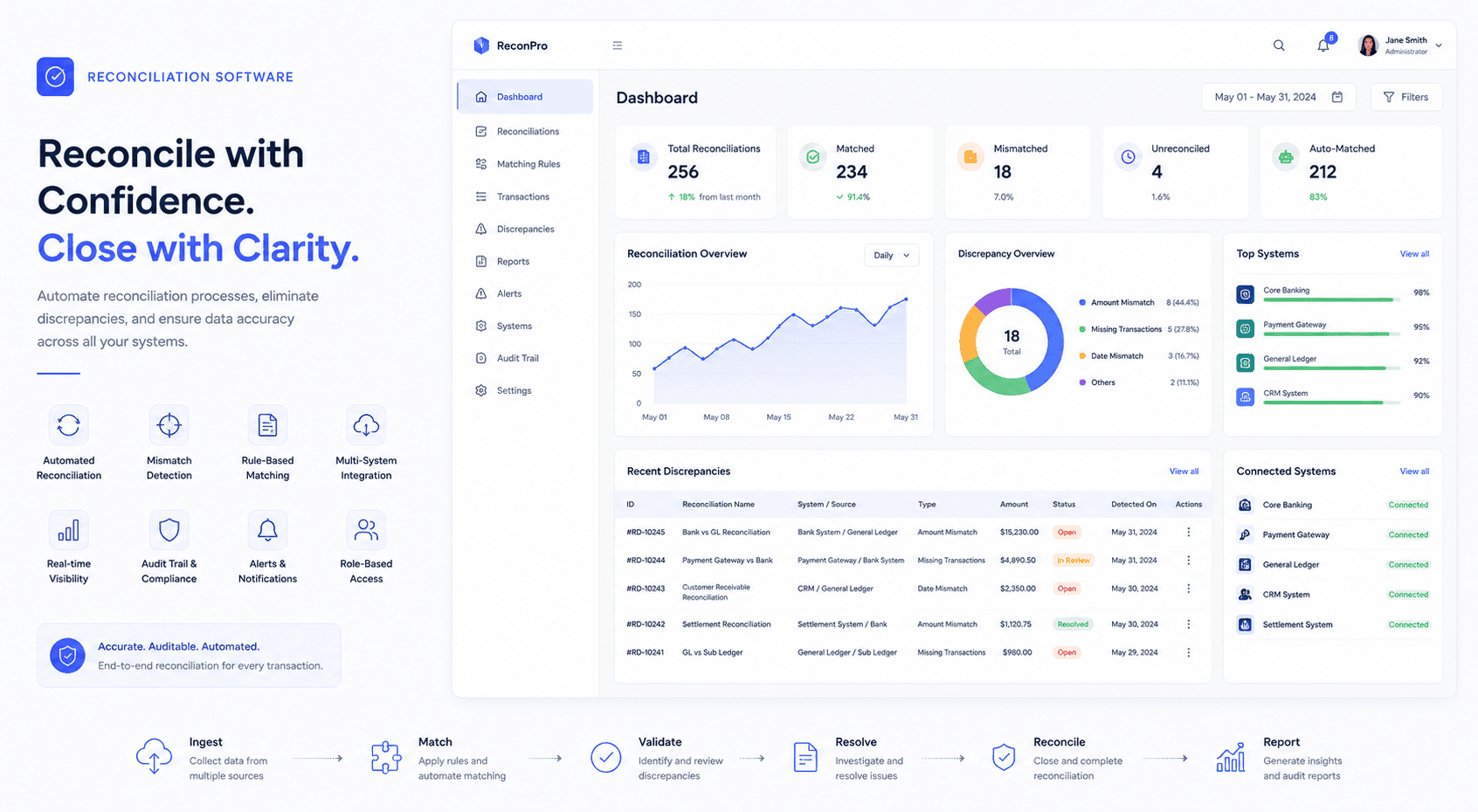
Key Features
two-way to multi-source flows; exact, composite, tolerance, fuzzy, rule-based, manual and justified force-match; one-to-one through many-to-many
unmatched records carry forward across cycles until resolved or expired
historical runs against past business or statement dates, independent of run date
end-to-end exception management with ageing
sources across API, file, database, SFTP/FTP, email, cloud storage and streaming/webhook
business analysts configure new sources and rules with no IT dependency, over an immutable audit trail
How It Works
datasets connect across API, file, database, SFTP, email, cloud storage or streaming, with schema and data-quality management.
a business analyst defines matching, validation and exception rules in the rule engine, without a development cycle.
jobs trigger on calendar or frequency, or run historically against past business dates.
the engine reconciles across the configured models and methods, from exact to fuzzy to justified force-match.
unmatched records carry forward and age through SLA-driven exception workflows until resolved or expired.
every action lands in an immutable audit trail for internal-control and regulatory demonstration.
FAQ
No. It is deliberately industry-agnostic and makes no assumption about domain, regulatory regime or data semantics — a shared horizontal utility.
No. Business analysts configure new sources and matching rules through self-service, removing the IT dependency.
Two-way, three-way, multi-way and multi-source in a single flow, with one-to-one, one-to-many, many-to-one, many-to-many and multi-source models.
Unmatched records carry forward across cycles until resolved or expired, managed through SLA-driven exception workflows with ageing.
Yes. Historical reconciliation runs against past business or statement dates, independent of the run date.
Force-match is an approver override applied when needed; it requires recorded justification and is captured in the immutable audit trail.
API, file, database, SFTP/FTP, email, cloud storage and streaming/webhook channels.
Typically the CFO or Financial Controller as sponsor, with business/data analysts configuring and reconciliation analysts operating it, under internal-audit oversight.
Sector-neutral by design, it applies across BFSI, payments, retail, fuel and energy, telecom, loyalty and shared services — reconciling settlement, inventory, order-to-cash, loyalty accrual and master data.