Real-Time Vehicle Tracking
Monitor the live location and movement of vehicles through GPS-enabled tracking devices and centralized fleet dashboards.

GPS Tracking for Fleet Management
Managing a modern fleet requires more than knowing where vehicles are located. Businesses need real-time visibility into vehicle movement, driver behavior, fuel usage, maintenance, routes, and delivery operations.
What Is GPS Tracking for Fleet Management?
GPS tracking for fleet management uses GPS-enabled tracking devices installed in vehicles to capture location, movement, speed, route, and other operational information.
When combined with IoT technology, GPS tracking becomes more than a location-monitoring tool. Connected vehicles can transmit real-time information to a centralized fleet management platform where businesses can monitor and analyze fleet performance.
This enables fleet managers to make faster, data-driven decisions and improve overall fleet efficiency.
Vehicle location
Vehicle movement
Route history
Speed and driving behavior
Fuel consumption
Engine performance
Vehicle utilization
Idle time
Delivery status
Maintenance requirements
Geofencing events
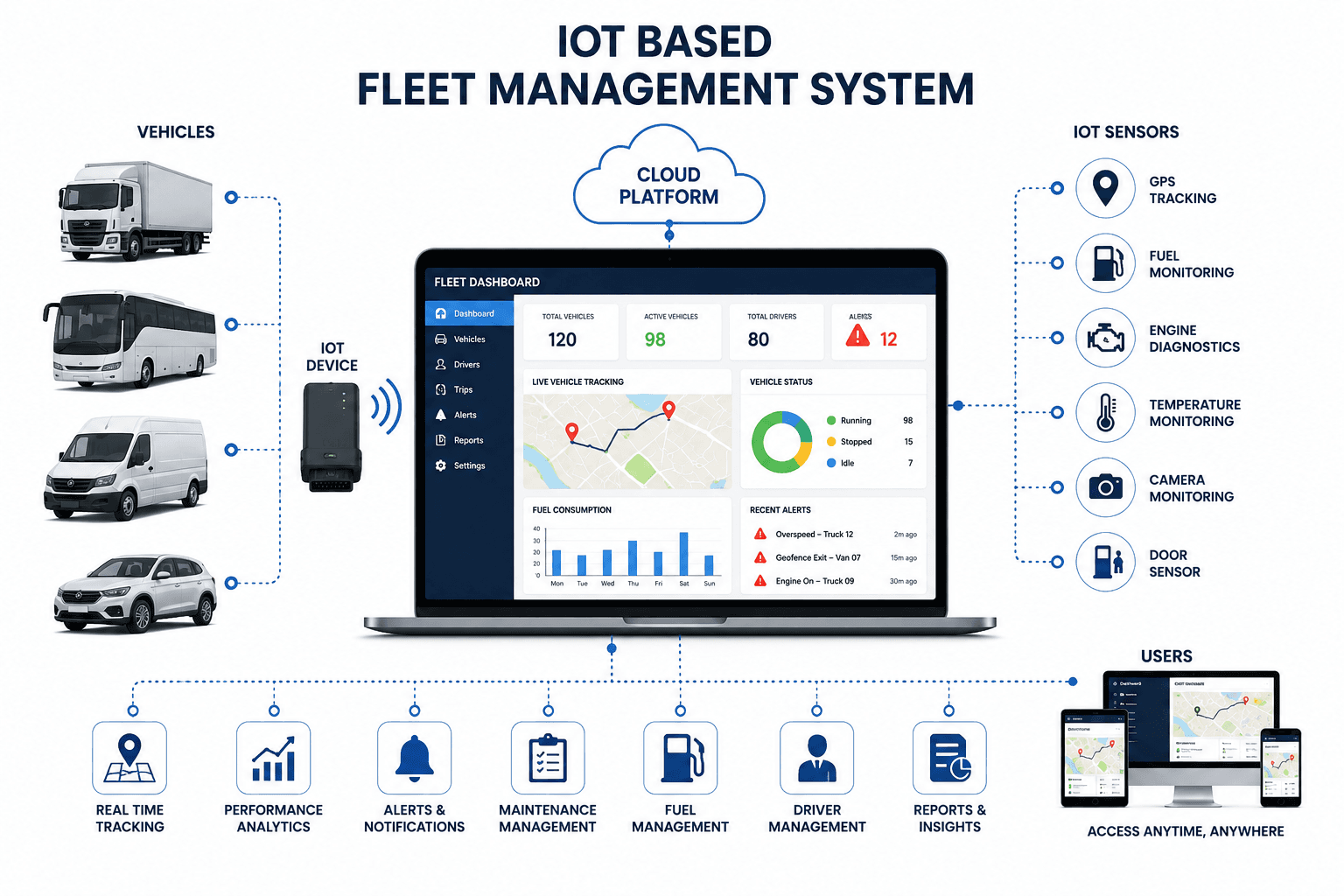
How IoT Is Transforming Fleet Management
The integration of IoT in supply chain management is transforming how businesses monitor vehicles, shipments, drivers, and logistics operations. Connected vehicles continuously generate data that can be used to improve transportation efficiency and supply-chain visibility.
Monitor the live location and movement of vehicles through GPS-enabled tracking devices and centralized fleet dashboards.
Analyze vehicle routes, traffic conditions, delivery schedules, and historical journey data to identify more efficient routes.
Monitor speeding, harsh braking, rapid acceleration, excessive idling, and other driving events to improve fleet safety and efficiency.
Track fuel consumption, fuel usage patterns, and abnormal fuel-related events to identify potential inefficiencies.
Connect vehicle sensors and diagnostic systems to monitor engine performance, operating conditions, and maintenance indicators.
Create virtual geographic boundaries and receive automated alerts when vehicles enter or leave predefined areas.
Track delivery progress and vehicle movement to provide greater visibility across transportation operations.
Fleet Management Platform
Our fleet management platform brings GPS tracking, IoT data, vehicle information, analytics, and operational workflows together in one centralized environment.
Monitor all connected vehicles on an interactive map with real-time status information.
Maintain vehicle profiles, documents, specifications, service history, and operational information.
Manage driver profiles, assignments, driving events, performance, and operational activity.
Plan trips, monitor routes, track deviations, and analyze historical journeys.
Create geographic boundaries and configure automated entry and exit notifications.
Configure alerts for speeding, unauthorized movement, route deviations, prolonged idling, maintenance conditions, and other events.
Track vehicle service schedules, maintenance activities, repairs, and maintenance-related alerts.
Analyze fleet utilization, mileage, fuel consumption, driver performance, vehicle performance, and operational efficiency.
Provide fleet managers and field teams with mobile access to vehicle information and alerts.
Automobile Tracking System
An automobile tracking system provides businesses with centralized visibility into their vehicles and fleet operations.
Each vehicle can be connected to a GPS tracker or IoT-enabled device that communicates operational data to a centralized cloud platform. Fleet managers can access vehicle information through web dashboards and mobile applications, allowing them to monitor fleet activity from anywhere.
Commercial trucks
Delivery vans
Passenger vehicles
School buses
Construction vehicles
Field-service vehicles
Emergency vehicles
Rental vehicles
Logistics vehicles
Heavy commercial vehicles
GPS for Commercial Vehicles
Using GPS for commercial vehicles enables businesses to monitor vehicle locations, routes, driving behavior, and operational activity.
Know where every vehicle is located and monitor its movement in real time.
Review historical routes to understand travel patterns and identify opportunities for optimization.
Track vehicle speeds and generate alerts when predefined speed limits are exceeded.
Receive notifications when vehicles enter or exit designated locations.
Monitor driving events and identify patterns that may affect safety, fuel efficiency, or vehicle performance.
Understand how frequently vehicles are being used, how long they remain idle, and how efficiently fleet resources are being utilized.
GPS Tracking for Commercial Vehicles
GPS tracking for commercial vehicles helps businesses maintain better control over large and distributed fleets. When integrated with IoT sensors and vehicle data, GPS tracking can become a comprehensive fleet intelligence platform.
Monitor vehicle locations
Improve dispatch operations
Reduce unnecessary travel
Track delivery progress
Monitor driver behavior
Improve customer communication
Respond to route deviations
Investigate vehicle incidents
Improve fleet utilization
Support fleet security
Tracking Device for Automobiles
A tracking device for automobiles can capture GPS location and transmit vehicle information to a centralized platform. The device communicates with the IoT platform through available cellular or other supported connectivity technologies.
This data can then be visualized through fleet dashboards, mobile applications, reports, and automated alerts.
GPS coordinates
Speed
Direction
Ignition status
Vehicle movement
Battery status
Engine parameters
Fuel information
Diagnostic data
Sensor readings
IoT Logistics & Supply Chain Management
Modern logistics and supply chain management requires visibility across transportation, warehouses, inventory, vehicles, and deliveries. IoT logistics connects these physical operations with digital platforms, enabling businesses to monitor assets and transportation activities in real time.
Track vehicles and shipments throughout their journey.
Monitor location, environmental conditions, and delivery status for connected shipments.
Connect vehicle movement with warehouse operations, loading, unloading, and dispatch workflows.
Synchronize transportation activity with inventory and order management systems.
Analyze transportation data to identify delays, bottlenecks, route inefficiencies, and operational trends.
IoT in Supply Chain Management
The application of IoT in supply chain management creates greater visibility across physical goods and transportation operations. This information can be integrated into supply-chain platforms to provide a more complete operational picture.
For temperature-sensitive logistics, for example, IoT sensors can continuously monitor environmental conditions and trigger alerts when predefined thresholds are exceeded.
Vehicle location
Shipment location
Inventory movement
Temperature
Humidity
Delivery status
Asset condition
Route deviations
Warehouse activity
Smart Fleet Management Use Cases
Track commercial vehicles, optimize routes, monitor deliveries, and improve fleet utilization.
Monitor last-mile delivery vehicles and provide real-time visibility into delivery operations.
Track service vehicles, coordinate field teams, and optimize technician routes.
Monitor heavy equipment, commercial vehicles, project logistics, and asset movement.
Track transportation vehicles, tankers, field-service vehicles, and operational assets.
Monitor school buses, routes, vehicle locations, and transportation activity.
Track emergency vehicles and support faster dispatch and route coordination.
Monitor vehicle locations, utilization, mileage, and operational activity.
Benefits of GPS Fleet Tracking
Analyze routes, idling, driving behavior, and vehicle utilization to identify opportunities for fuel savings.
Monitor driving events and vehicle activity to encourage safer driving practices.
Understand how vehicles are being used and identify underutilized fleet resources.
Provide real-time visibility into vehicle movement and delivery progress.
Use GPS tracking and geofencing to identify unusual vehicle movement or unauthorized trips.
Use vehicle data and maintenance schedules to identify service requirements and reduce unexpected downtime.
Our Fleet IoT Development Services
We provide end-to-end Internet of Things application development services for organizations looking to build connected fleet and logistics platforms.
Fleet IoT Consulting
GPS Tracking Solutions
Vehicle Tracking Platform Development
IoT Device Integration
GPS Tracker Integration
Vehicle Telematics
Fleet Management Software
Driver Monitoring Solutions
Route Optimization
Geofencing Solutions
Fuel Monitoring
Vehicle Health Monitoring
Predictive Maintenance
Fleet Analytics
Logistics IoT Solutions
Supply Chain IoT Integration
Mobile Fleet Applications
IoT Dashboard Development
Cloud IoT Development
Enterprise System Integration
IoT Security
IoT Support & Maintenance
Whether you need a simple automobile tracking system or a complete IoT-powered fleet management platform, we can build a solution around your business requirements.
Why Choose Us for Fleet IoT Solutions?
Fleet management requires reliable connectivity, accurate location data, scalable platforms, intuitive applications, and meaningful analytics.
From strategy and architecture to device integration, application development, deployment, and ongoing support.
Build fleet management applications around your vehicles, drivers, workflows, logistics processes, and business requirements.
Monitor vehicles and operational data through centralized web and mobile applications.
Build solutions that can support fleets ranging from a small number of vehicles to large distributed transportation networks.
Connect fleet data with logistics, warehouse, inventory, ERP, and supply-chain systems.
Implement device authentication, access control, data protection, monitoring, and secure communication throughout the IoT ecosystem.
The Future of Fleet Management Is Connected
The future of transportation will be driven by connected vehicles, IoT sensors, real-time analytics, AI, and intelligent automation.
GPS tracking for fleet management provides the foundation for this transformation by connecting vehicles with digital platforms. When GPS data is combined with vehicle telemetry, logistics information, supply-chain systems, and AI-powered analytics, organizations can gain a much deeper understanding of their transportation operations.
The result is a fleet that is more visible, efficient, safer, and responsive.
Build Your Connected Fleet Management Solution
Looking to implement GPS tracking, connect your commercial vehicles, improve logistics visibility, or build an IoT-powered fleet management platform? Our IoT specialists can help you select the right tracking devices, connectivity, platform architecture, applications, analytics, and integrations for your fleet.