Smart Inventory Management
IoT-enabled systems can track products and inventory in real time, helping retailers understand what is available, where products are located, and when stock needs replenishment.

IoT Applications for Smart Retail
Retail is rapidly evolving as businesses adopt connected devices, automation, artificial intelligence, and real-time analytics to create smarter shopping experiences and more efficient operations. IoT applications for smart retail connect stores, products, shelves, inventory, customers, and business systems to create a unified digital retail ecosystem.
What Is Smart Retail?
Smart retail uses connected technologies to create a more intelligent and automated retail environment. IoT devices and sensors collect real-time information from stores, inventory, shelves, equipment, and customer interactions.
This information can be analyzed through centralized platforms to provide actionable insights and automate operational processes. By connecting these data sources, retailers can gain greater visibility into what is happening across stores and respond faster to changing conditions.
Inventory levels
Product movement
Shelf availability
Customer footfall
Store occupancy
Equipment conditions
Cold-chain temperatures
Energy consumption
Point-of-sale activity
Customer interactions
Product locations
IoT Applications for Smart Retail
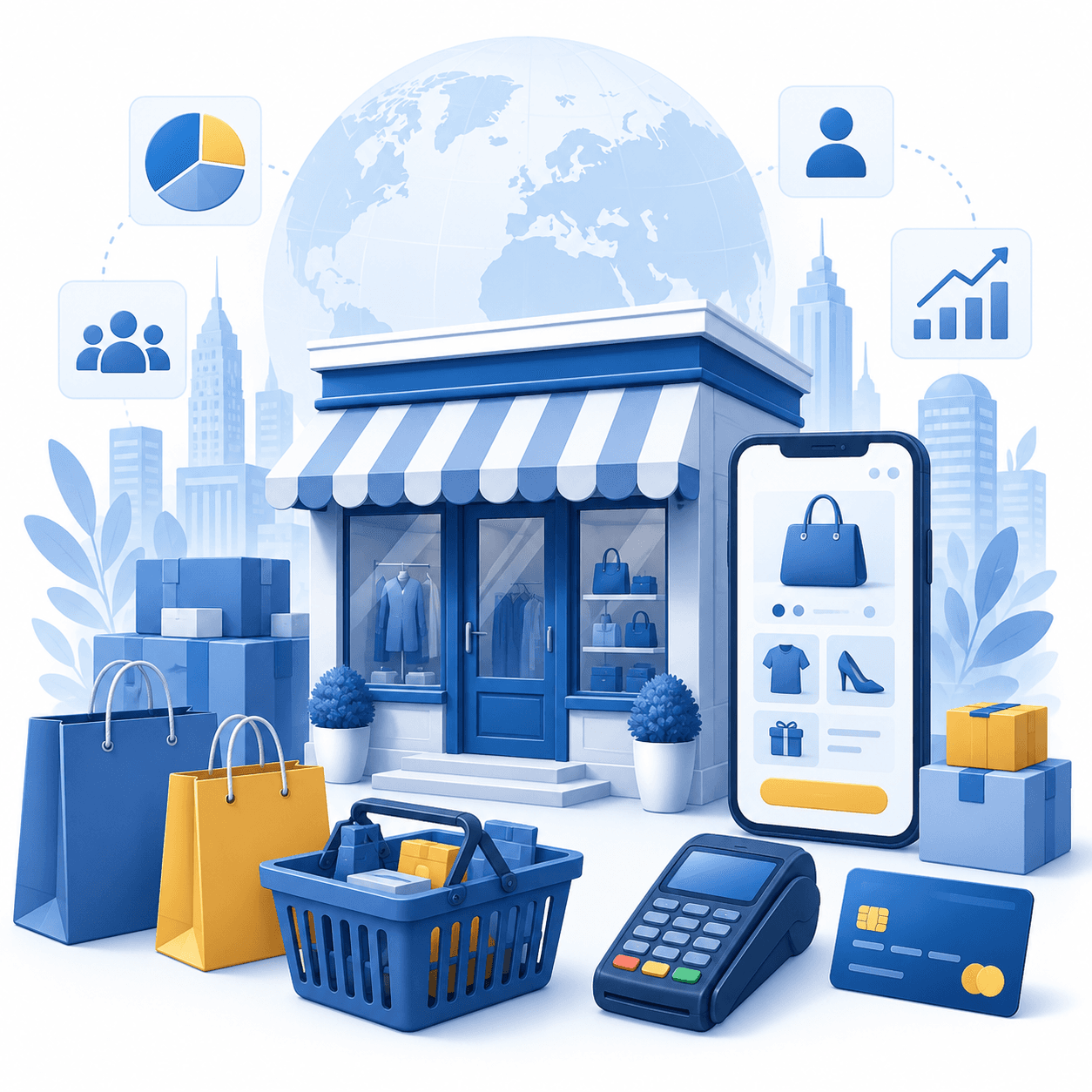
There are many IoT applications for smart retail, ranging from inventory management and asset tracking to customer experience and store automation.
IoT-enabled systems can track products and inventory in real time, helping retailers understand what is available, where products are located, and when stock needs replenishment.
Connected shelves can monitor product availability and detect changes in inventory, helping store teams identify empty or low-stock shelves faster.
Track shopping carts, equipment, displays, storage containers, and other retail assets using RFID, BLE, GPS, QR codes, and other connected technologies.
Connected sensors can provide information about store traffic, occupancy, and movement patterns to help retailers optimize store layouts and staffing.
Temperature and humidity sensors can continuously monitor refrigerators, freezers, and temperature-sensitive inventory.
Monitor lighting, HVAC systems, energy consumption, security equipment, and other store infrastructure from a centralized platform.
Configure alerts for low inventory, temperature changes, equipment failures, unauthorized movement, and other operational events.
IoT devices can support interactive displays, personalized experiences, location-based engagement, and other digital retail experiences.
Smart Retail Platform
A smart retail platform brings IoT devices, store systems, analytics, and business applications together in one centralized environment.
Register, configure, monitor, and manage connected sensors, gateways, trackers, cameras, and other retail devices.
Monitor product quantities, locations, movements, and stock conditions across stores and warehouses.
Track store-level conditions such as occupancy, temperature, energy consumption, equipment health, and security events.
Give retail managers centralized visibility into operational KPIs and connected devices.
Receive immediate notifications when predefined conditions or thresholds are triggered.
Analyze sales-related operational data, inventory trends, customer activity, equipment performance, and other business metrics.
Monitor multiple stores, locations, warehouses, and facilities through a centralized platform.
Artificial Intelligence in Retail Industry
The artificial intelligence in retail industry is changing how businesses understand customers, manage inventory, and optimize store operations. IoT provides continuous real-world data, while AI can analyze that information to identify patterns, predict trends, and support intelligent decision-making.
AI can analyze historical sales, inventory, seasonal trends, customer behavior, and other data to support more accurate demand forecasting.
AI can analyze customer behavior and preferences to support more relevant product recommendations and personalized experiences.
AI-powered analytics can identify demand patterns and help retailers optimize inventory levels and replenishment strategies.
AI-powered cameras can support applications such as shelf monitoring, product recognition, customer traffic analysis, and loss-prevention workflows.
Analyze customer movement and interaction patterns to help retailers understand how shoppers engage with physical store environments.
AI can analyze equipment data to identify potential failures and support proactive maintenance of refrigeration, HVAC, and other retail infrastructure.
AI in Retail Industry + IoT
The combination of AI in retail industry applications with IoT creates a powerful technology ecosystem. Consider a connected retail store where sensors monitor shelf inventory, cameras analyze store activity, and IoT devices track equipment conditions. AI can bring these data sources together to identify patterns and generate recommendations.
IoT Sensors → Real-Time Data → Cloud Platform → AI Analytics → Intelligent Recommendation → Automated Action.
This approach can help retailers move from simply monitoring store conditions to proactively optimizing operations.
Smart Retail Use Cases
Monitor shelves, inventory, refrigeration systems, customer movement, energy consumption, and store infrastructure.
Track products, inventory, customer movement, fitting-room activity, and store assets.
Use IoT for inventory monitoring, cold-chain management, smart shelves, and store environment monitoring.
Monitor inventory, storage conditions, temperature-sensitive products, and connected equipment.
Monitor occupancy, energy usage, facility systems, security, parking, and other connected infrastructure.
Track inventory, assets, environmental conditions, equipment, and material movement throughout the facility.
Use connected technologies to improve inventory visibility, equipment monitoring, energy management, and store operations.
Benefits of IoT for Smart Retail
Real-time tracking reduces dependence on manual inventory checks and provides better visibility into product availability.
Automated monitoring can help identify low-stock conditions earlier and support faster replenishment.
Connected tracking technologies can improve visibility into product movement and help identify unusual activity.
Connected technologies can support personalized, convenient, and responsive retail experiences.
Real-time information helps managers understand store conditions and identify operational inefficiencies.
Monitor HVAC, lighting, refrigeration, and other energy-consuming equipment to identify opportunities for optimization.
Combine IoT data with analytics and AI to generate actionable insights for store managers and retail executives.
Custom IoT Development Services for Retail
Every retailer has different stores, products, customers, workflows, and technology environments. Our custom IoT development services help retailers build connected solutions around their specific operational requirements.
IoT Strategy & Consulting
Smart Retail Platform Development
IoT Device Integration
Smart Shelf Solutions
Inventory Tracking Solutions
RFID & BLE Integration
Store Monitoring Systems
Customer Footfall Analytics
Cold Chain Monitoring
Retail Asset Tracking
IoT Dashboard Development
Retail Mobile App Development
AI & Machine Learning Integration
Computer Vision Solutions
Predictive Analytics
Cloud IoT Development
Enterprise System Integration
IoT Security
IoT Support & Maintenance
Whether you need a connected retail application, multi-store IoT platform, inventory tracking solution, or AI-powered retail system, we can help design and develop the technology around your business objectives.
Why Choose Us as Your IoT Development Company?
Selecting the right IoT development company is important when building a scalable retail technology ecosystem. We combine IoT engineering, cloud development, AI, analytics, application development, and enterprise integration.
From strategy and architecture to device integration, software development, deployment, and ongoing support.
We design IoT solutions around real retail workflows, including stores, inventory, warehouses, equipment, and customer experiences.
Build solutions that can grow from a single connected store to large multi-location retail networks.
Combine real-time IoT data with AI and analytics to generate intelligent insights and recommendations.
Build web and mobile applications for store managers, operations teams, inventory managers, administrators, and business leaders.
Implement appropriate authentication, access controls, device security, monitoring, and data protection across the IoT ecosystem.
IoT SaaS for Smart Retail
The rise of IoT SaaS companies is enabling businesses to access connected technology through scalable cloud-based platforms rather than managing complex infrastructure independently.
This approach can make it easier for retailers to deploy connected technology across multiple locations while maintaining centralized control.
Cloud-based IoT device management
Multi-store management
Centralized dashboards
Real-time monitoring
Automated alerts
Analytics and reporting
User and role management
Device provisioning
API integrations
Subscription-based scalability
The Future of Retail Is Intelligent
The future of retail will be shaped by the convergence of IoT, artificial intelligence, automation, computer vision, cloud computing, and data analytics.
Connected devices will provide real-time visibility. AI will transform that data into intelligent insights. Automation will turn insights into actions. The result is a new generation of retail environments that are more connected, efficient, personalized, and responsive.
IoT applications for smart retail are not simply about connecting devices—they are about creating an intelligent digital layer across the entire retail operation.
Build Your Smart Retail Solution
Looking to improve inventory visibility, build a connected store, optimize retail operations, or create an AI-powered customer experience? Our IoT specialists can help you identify the right devices, architecture, applications, AI capabilities, and integration strategy for your retail business.
