Monitoring
A unified operational picture across every connected system, sensor network, and data source, giving command teams continuous situational awareness without the cognitive overhead of managing multiple independent feeds simultaneously.

Public Infrastructure
Command environments don't fail because the people in them are underprepared. They fail because the information architecture feeding those people wasn't built for the speed, volume, and cross-source complexity of a real incident. We build command and control infrastructure that structures multi-source operational data into a verified, prioritized situational picture.
Product Overview
Under Pressure, the Quality of a Decision Is Determined by the Quality of the Picture That Preceded It.
Command environments don't fail because the people in them are underprepared. They fail because the information architecture feeding those people wasn't built for the speed, volume, and cross-source complexity of a real incident. We build command and control infrastructure that structures multi-source operational data into a verified, prioritized situational picture.
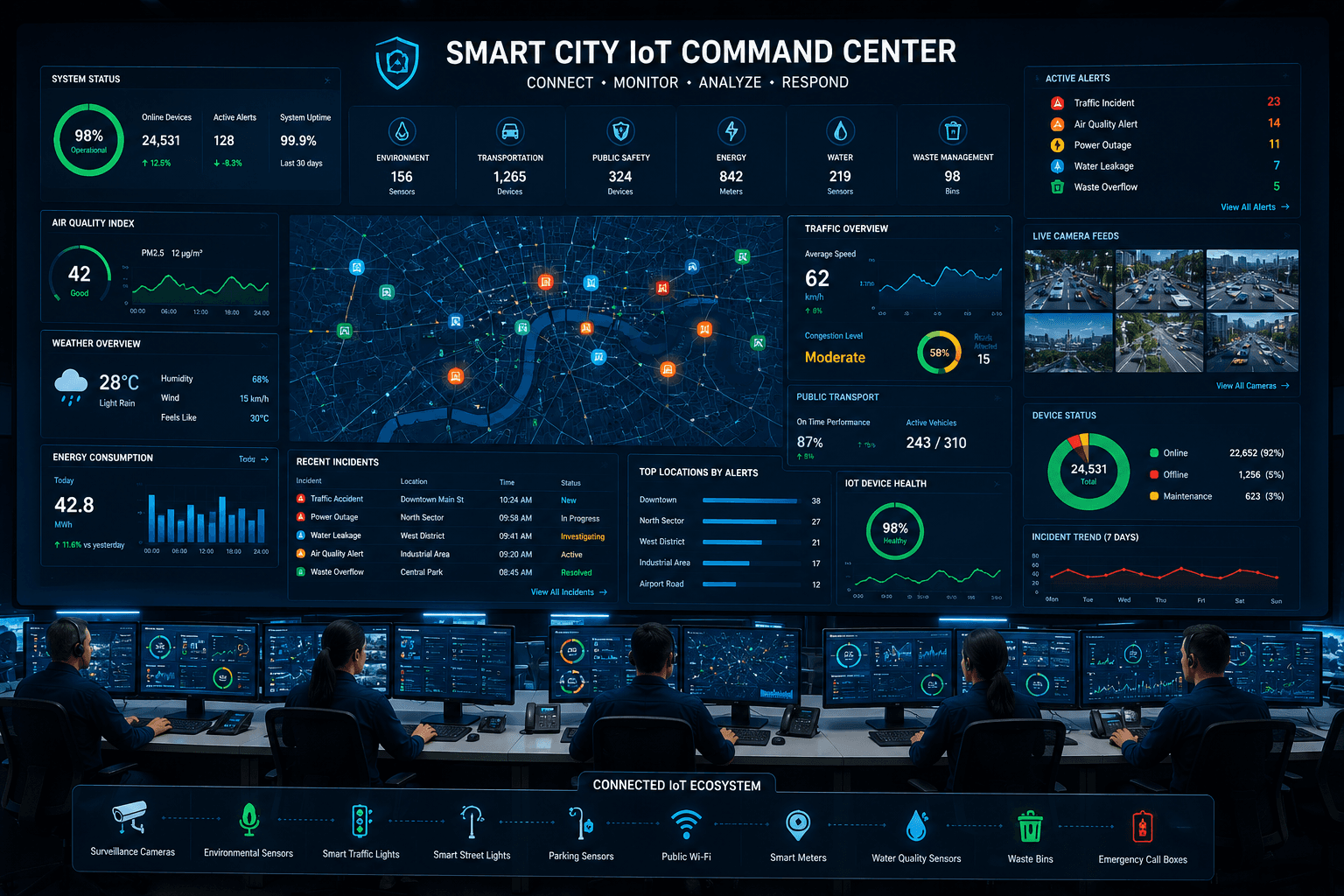
Command Center connects alerts, operators, locations, device health, and reports for mission-critical response teams, reducing noise while surfacing the incidents that demand immediate action.
Key Features
A unified operational picture across every connected system, sensor network, and data source, giving command teams continuous situational awareness without the cognitive overhead of managing multiple independent feeds simultaneously.
AI-driven anomaly detection and event classification across all connected data sources identifies incidents, escalations, and critical threshold breaches automatically.
A complete, tamper-evident operational record of every event, decision, and communication, providing the incident reconstruction capability post-event reviews require.
Centralized management of every connected device feeding the command environment, from surveillance cameras to IoT sensors, ensuring the data sources command decisions depend on are monitored continuously.
How It Works
Every data source feeding the command environment is onboarded through a unified ingestion layer that enforces normalization, timestamping, and source authentication.
Continuous AI analysis runs across the full data volume, classifying events by type, severity, affected domain, and relationship to active incidents.
Every verified event enters a structured command workflow. Resources are dispatched, teams are coordinated, and escalation paths are followed, all within the same platform.
Every incident is reconstructable in full sequence so post-incident analysis, regulatory submissions, and operational improvement reviews draw from a record built continuously during operations.
Command Center connects alerts, operators, locations, device health, and reports for mission-critical response teams, reducing noise while surfacing the incidents that demand immediate action.