Monitoring
A unified operational view across traffic, utilities, public safety, and civic infrastructure, giving city operations centers visibility into every managed system without requiring operators to switch between department-specific consoles.


Public Infrastructure
Traffic operations, utilities, public safety, and civic services generate operational data independently and act on it independently, which means the incidents that cross departmental boundaries are exactly the ones that fall through the cracks. We build the integration layer that connects city infrastructure into a single operational picture.
Product Overview
Every City Department Is Managing Its Piece of the City. Nobody Is Managing the City.
Traffic operations, utilities, public safety, and civic services generate operational data independently and act on it independently, which means the incidents that cross departmental boundaries are exactly the ones that fall through the cracks. We build the integration layer that connects city infrastructure into a single operational picture.
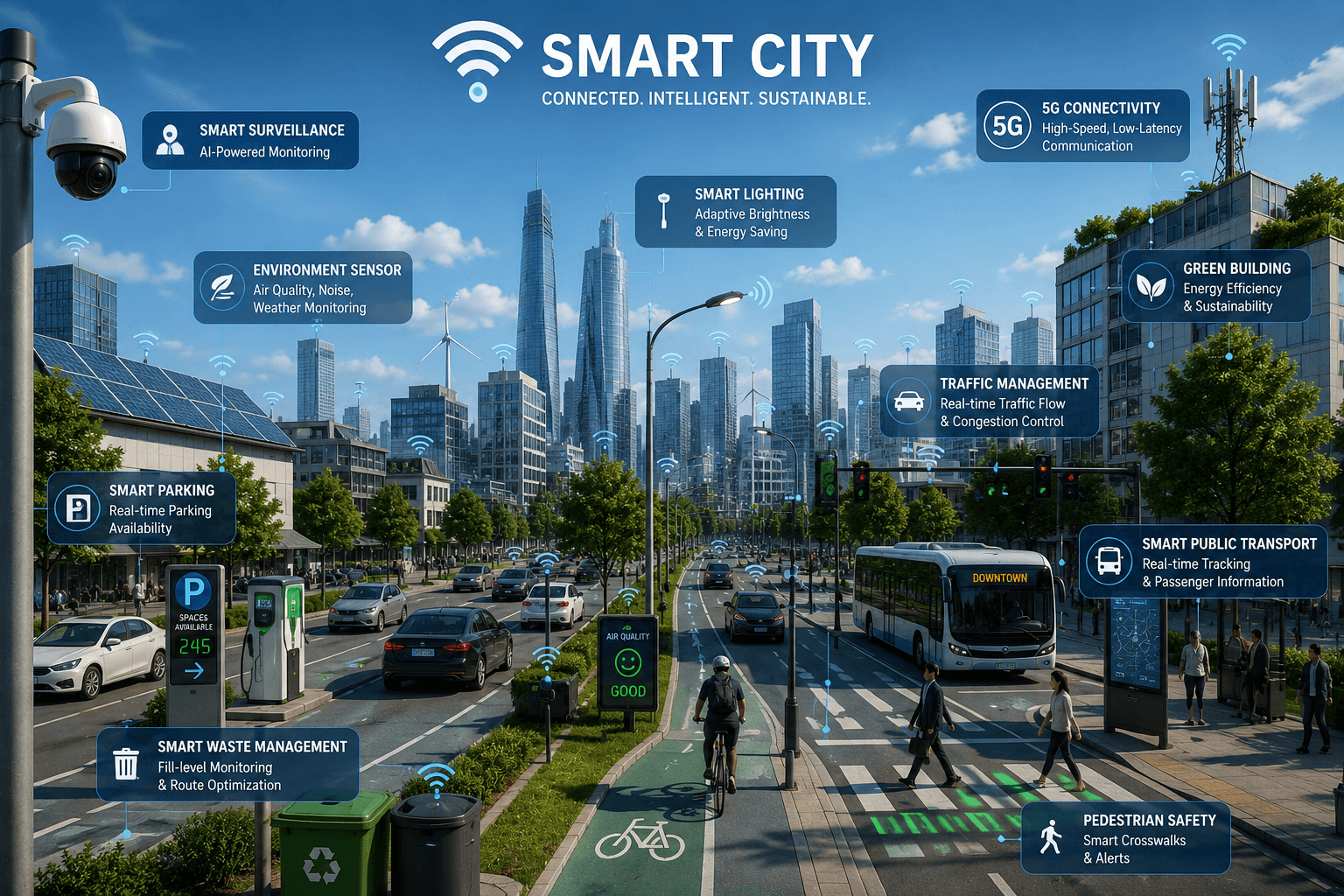
Replace siloed dashboards with a governed city data layer. Smart City connects departments that previously worked in isolation so city operations centers can coordinate on one shared picture.
Key Features
A unified operational view across traffic, utilities, public safety, and civic infrastructure, giving city operations centers visibility into every managed system without requiring operators to switch between department-specific consoles.
Automated anomaly detection across sensor networks identifies infrastructure stress, traffic incidents, environmental threshold breaches, and public safety events as they develop.
A complete, timestamped record of urban operational data retained for planning, audit, and policy review, giving city leadership the evidence base infrastructure investment decisions require.
Centralized health monitoring and configuration management across every connected city device, from traffic sensors to environmental monitors, ensuring the infrastructure underpinning city intelligence stays operational at scale.
How It Works
Traffic sensors, utility meters, environmental monitors, public safety cameras, and civic IoT devices feed into a unified city data layer through standardized protocols that accommodate the infrastructure heterogeneity every city actually has.
Continuous analysis runs against operational baselines calibrated to each infrastructure domain. Classification happens at domain level, then cross-referenced for incidents that span multiple systems.
When an incident touches multiple departments, the platform routes structured alerts to each simultaneously with shared situational context rather than separate notifications each team has to reconcile independently.
The operational record accumulated across daily city management becomes the evidence base for infrastructure investment decisions, policy reviews, and performance accountability.
Replace siloed dashboards with a governed city data layer. Smart City connects departments that previously worked in isolation so city operations centers can coordinate on one shared picture.